
The short answer is maybe. Though there are 870 pages of the recently passed federal budget act (One Big Beautiful[1] Budget Act or “OBBBA”), nothing in it changed the formula for taxing Social Security benefits. I’ll describe how this works later in this post, if you’re interested in the math. And please note, I’m only talking about federal taxation here—there are still a handful of states that tax Social Security benefits.
The New “Enhanced” Deduction for Taxpayers 65 and older
While nothing has changed on how Social Security, specifically, is taxed, for a few years there will be a tax break for older people. Everyone who is 65 or older and has annual income[2] of less than $75,000 (single, “S”) or $150,000 (married filing jointly, “MFJ”) will receive an “enhanced” deduction of $6,000, starting in 2025 and ending in 2028. During these four years, those who meet the income requirements, will receive this additional deduction. It will be used to offset any kind of taxable income (wages, business income, pension benefits, investment income, taxable Social Security benefits). You don’t have to be taking Social Security benefits to get the extra deduction and you can take it along with the standard deduction, which more than 90% of Americans take, or along with your itemized deductions.
What happens if you are over 65 and have more than $150,000 (MFJ) or $75,000 (S) of income? The enhanced deduction is reduced by 6% of the amount that income exceeds the threshold. The entire $6,000 per person deduction will be reduced to zero at income of $250,000 (MFJ) and $175,000 (S).
Examples:
A single person with income of $100,000 will have the enhanced deduction reduced from $6,000 to $4,500 (6% of the $25,000 over the threshold is $1,500).
For married couples, the 6% reduction is applied to each person’s enhanced deduction. A couple with income of $175,000, $25,000 over the threshold, will have this extra deduction reduced from $12,000 to $9,000. Six percent of $25,000 is $1,500 and this reduction is applied to each person’s $6,000 enhanced deduction.
How Social Security Benefits Continue to be Taxed
If I haven’t lost you yet, you must love math or income tax calculations or both, like I do! And you’re wondering if and how Social Security benefits continue to be taxed, as they have since this formula was first put in place in the 1984 and then expanded in 1993. The taxpayer’s “provisional income” is used to determine if and how much of Social Security benefits are taxable. “Provisional income” is basically all forms of income included in adjusted gross income with the addition of tax-exempt interest and one half of Social Security benefits. Then provisional income (“PI”) is used to determine if any or some part of the taxpayer’s Social Security benefits will be taxed as shown in this table:
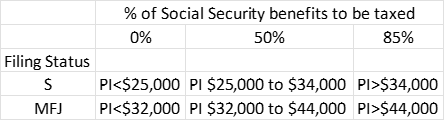
These threshold numbers were put in place in 1984 (for 50% of Social Security to be taxable) and 1993 (for 85% of Social Security to be taxable) and are not indexed for inflation. In 1984, $25,000 was more than five times the national poverty level for an individual. In 2024, it was only 1.7 times. And in 1993, $34,000 was 4.9 times the individual national poverty level; in 2024 it was 2.3 times. Because these numbers haven’t risen with inflation, Social Security benefits are now taxable for many more middle and lower income families than they were at the outset. Today, only those whose Social Security benefits aren’t large and who have no other income will have their Social Security benefits exempt from Federal income tax.
Making decisions on when to take Social Security benefits and planning for the income tax consequences of choices is all part of the work I do with clients. If you need help, send me a message!
Investment advisor representative of and investment advisory services offered through CGN Advisors, LLC, a fee-only SEC registered investment advisor. Tel: (910) FEE-ONLY. Fair Winds Financial Advice may offer investment advisory services in the State(s) of North Carolina, Texas and in other jurisdictions where exempted. Click here for additional disclosures.
[1] Beauty is in the eye of the beholder--Margaret Wolff Hungerford, Molly Bawn
[2] For purposes of this limitation, income is Adjusted Gross Income plus any income earned while residing in U.S. territories or possessions like Puerto Rico, the Virgin Island, Guam, American Samoa and the Northern Mariana Islands.